Sunday, 6 February 2011
Title Sequences that inspire me ! ; Casino Royale
Daniel Klienman is a British director most famous for creating title sequences for James Bond, the movie. Klienman’s title sequence for ‘Casino Royale’ involved black and white images of Bond, filled with different patterns and symbolic objects such as cards. Klienman’s work is done in a collage style with a collection of different images stuck together. To create his work Klienman uses computer generated images. His style of work is extremely decorative and symbolic.
When I initially saw Klienman’s work I thought it was interesting, I thought that the way in which he used different objects to symbolize the films narrative and plot was smart, it made me want to see more and more. After researching his work I thought that it might be good to incorporate this into my groups work later on because I liked the black and white effect.

Basic facts about fonts


Serif is a traditional font used for centuries it has something that we call a 'tail' at the end of each letter as shown in the image above. San Serif fonts are more modern and they do not contain tails there are more simplistic in terms of shape.
Camera shot lengths
1 . Extreme long shot
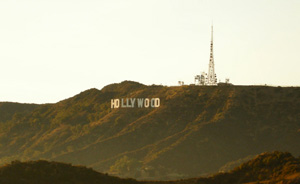
The extreme long shot on the left is taken from a distance, but denotes a precise location - it might even connote all of the entertainment industry if used as the opening shot in a news story.
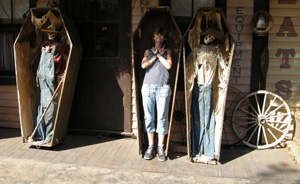
2. Long Shot
This is the most difficult to categorise precisely, but is generally one which shows the image as approximately "life" size ie corresponding to the real distance between the audience and the screen in a cinema (the figure of a man would appear as six feet tall). This category includes the FULL SHOT showing the entire human body, with the head near the top of the frame and the feet near the bottom. While the focus is on characters, plenty of background detail still emerges: we can tell the coffins on the right are in a Western-style setting, for instance.
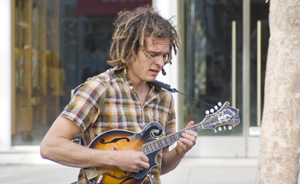
3. Medium Shot
Contains a figure from the knees/waist up and is normally used for dialogue scenes, or to show some detail of action. Variations on this include the TWO SHOT (containing two figures from the waist up) and the THREE SHOT (contains 3 figures...). NB. Any more than three figures and the shot tends to become a long shot. Background detail is minimal, probably because location has been established earlier in the scene - the audience already know where they are and now want to focus on dialogue and character interation. Another variation in this category is the OVER-THE-SHOULDER-SHOT, which positions the camera behind one figure, revealing the other figure, and part of the first figure's back, head and shoulder.
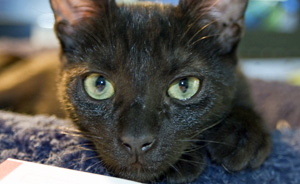
Close up
4. Close-Up
This shows very little background, and concentrates on either a face, or a specific detail of mise en scène. Everything else is just a blur in the background. This shot magnifies the object (think of how big it looks on a cinema screen) and shows the importance of things, be it words written on paper, or the expression on someone's face. The close-up takes us into the mind of a character. In reality, we only let people that we really trust get THAT close to our face - mothers, children and lovers, usually - so a close up of a face is a very intimate shot. A film-maker may use this to make us feel extra comfortable or extremely uncomfortable about a character, and usually uses a zoom lens in order to get the required framing.
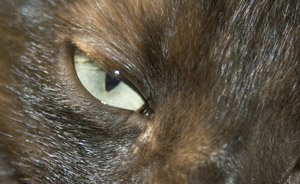
Extreme Close Up
5. Extreme Close-Up
As its name suggests, an extreme version of the close up, generally magnifying beyond what the human eye would experience in reality. An extreme close-up of a face, for instance, would show only the mouth or eyes, with no background detail whatsoever. This is a very artificial shot, and can be used for dramatic effect. The tight focus required means that extra care must be taken when setting up and lighting the shot - the slightest camera shake or error in focal length is very noticeable.
Ideas ; Camera Angles
The Bird's-Eye view

This shows a scene from directly overhead, a very unnatural and strange angle.
Eye Level

When a camera is placed approximately five to six feet from the ground.
Low Angle
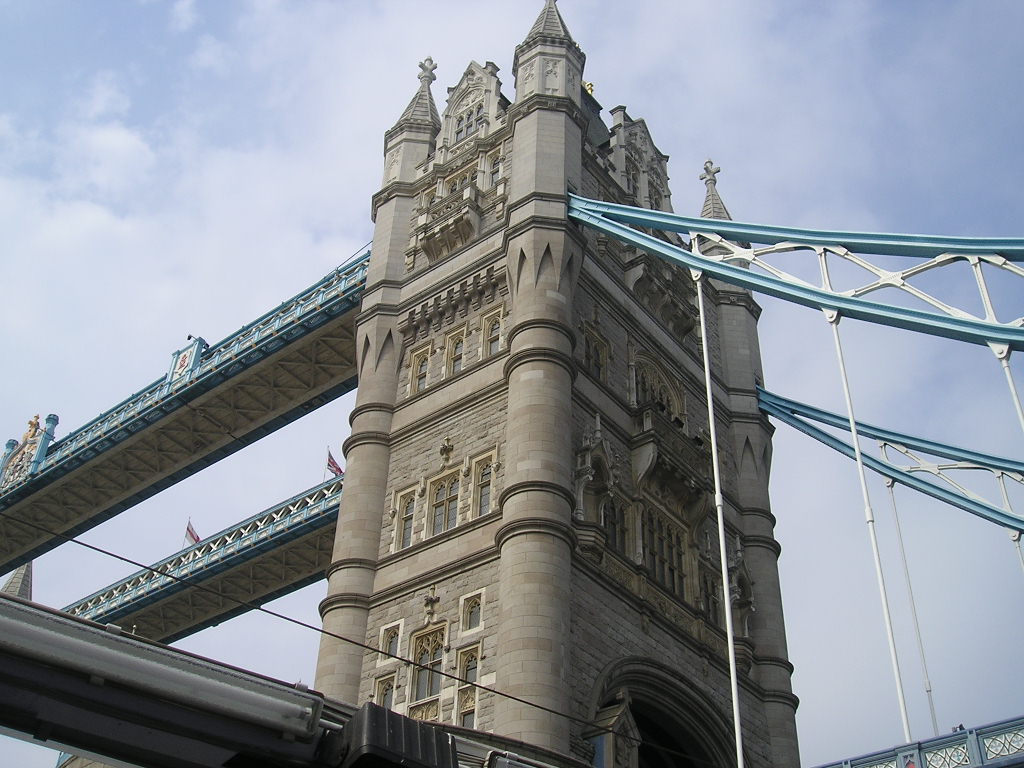
These increase height and give a sense of speeded motion. Low angles help give a sense of confusion to a viewer, of powerlessness within the action of a scene. The background of a low angle shot will tend to be just sky or ceiling, the lack of detail about the setting adding to the disorientation of the viewer. The added height of the object may make it inspire fear and insecurity in the viewer, who is psychologically dominated by the figure on the screen.
Oblique/Canted Angle

Sometimes the camera is tilted , to suggest imbalance, transition and instability , this isvery popular in horror/thirller movies.
Here's a video on camera angles

Friday, 4 February 2011
Camera Movements
In my groups thriller we are going to show a variety of camera movements. Camera movements can change the emotion of a particular scene and effectively will make it better. I decided to do some research on camera movements so that I can apply different ideas to my groups thriller film.
Check out the 6 Different camera movements below

Pans
A Panning shot is a horizontal movement. Once a camera is placed on a tripod, the tripod itself is a axis point and the camera is turned, often to follow a moving object which is kept in the middle of the frame.
Tilts
 A movement which is opposite to the pan shot being that it is a vertical movement.
 Tracking shot
 A shot that generally follows a moving figure or object, A tracking shot is a good way of following the journey of a character and making the audience focus on a object or character.
 Hand-held shots
A hand-held shot is basically when i person carries the camera in their hand. Hand held cameras denote a certain kind of gritty realism, they make the audience feel as though they are part of a scene.
Zoom Lenses
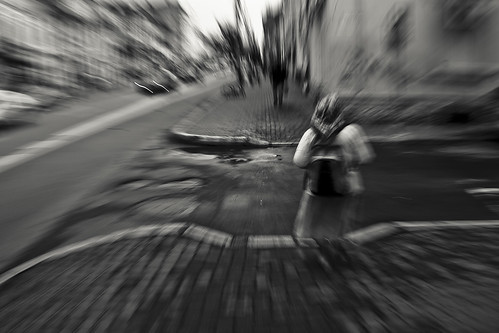
The Aerial Shot

Watch this video about camera movements !
Subscribe to:
Posts (Atom)